
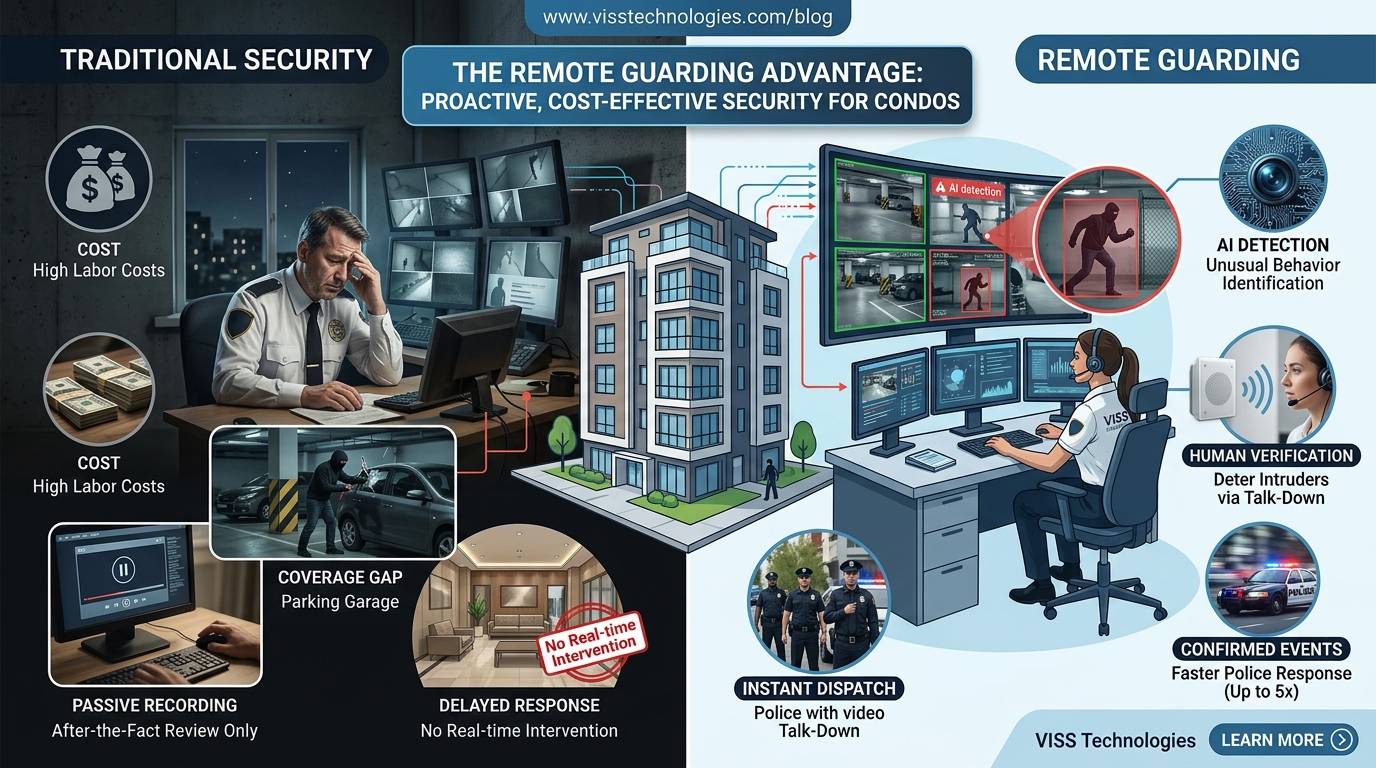
Traditional Security
For condominium and high-rise property managers, security is a persistent challenge. Hiring on-site guards is expensive — a single 24-hour post can consume a significant portion of a property's operating budget. And even with that investment, the results are often inconsistent.
On-site guards face structural limitations: fatigue during overnight shifts, limited patrol coverage, and the inability to watch multiple entry points and common areas simultaneously. Too often, guards become "after-the-fact recorders" rather than "before-the-fact interveners."
Meanwhile, multi-family residential properties are increasingly targeted by criminals. Parking garages, mailrooms, lobbies, and perimeter areas are exactly where security tends to be weakest.
Remote Guarding: How Technology Changes the Security Equation
Remote guarding replaces the traditional "human patrol + review footage later" model with a combination of "AI detection + human intervention in real time."
The system continuously analyzes video feeds through smart cameras. AI algorithms identify unusual behavior — someone loitering in a parking garage at night, a figure climbing a fence, suspicious activity in a restricted area. When a threat is detected, an alert is sent instantly to a remote monitoring center, where trained operators verify the event via video.
Verification is the critical step. Operators can issue a live audio warning (talk-down) through on-site speakers. In most cases, this alone is enough to deter intruders — no need to wait for police to arrive. If the situation escalates, operators can dispatch law enforcement immediately and send video evidence to officers in real time.
This "verify first, respond second" approach delivers a major advantage: police receive confirmed events, not alerts that could be false alarms. Video-verified alarms get a police response up to 5 times faster than standard alarms.
What Happens Without Remote Guarding
Security Blind Spots Persist
The problem with traditional cameras isn't whether they exist — it's who's watching. Most condominium video systems are only reviewed after an incident has already occurred. That means criminals can complete thefts, vandalism, or break-ins without any real-time intervention. Overnight hours are especially vulnerable — on-site guards may be patrolling other areas while the monitoring room sits empty.
The Cost-Effectiveness Imbalance
A guard team covering every entrance and common area can be prohibitively expensive. But cutting headcount creates gaps in coverage. Many property managers face an impossible choice: absorb high labor costs or accept security risks.
Losses from Delayed Response
When incidents depend on on-site staff or resident calls to be discovered, the response is already too late. Damage is done. Property is gone. For parking lot theft, mailroom intrusions, and vandalism of common areas, footage is useful for investigation — but it can't undo the loss.
Declining Resident Confidence
A sense of safety is a key driver of resident retention. When residents feel the building is no longer secure, renewal rates drop, negative reviews increase, and the property's reputation and revenue suffer.
The Measurable Value of Remote Guarding
Significant cost reduction. Compared to adding on-site guards, remote guarding can save 50% to 90%. One case study showed a 27-unit residential building saving approximately $4,000 per month after replacing overnight concierge coverage with remote guarding. A San Francisco office complex saved up to $100,000 per month with a remote solution.
Broader, more consistent coverage. A single remote operator can monitor multiple cameras and multiple properties simultaneously — far beyond what one on-site guard can patrol. AI systems don't get tired or distracted, maintaining vigilance 24/7.
From passive recording to active prevention. The core value of remote guarding is intervention. Audio warnings can stop criminal behavior before it's completed. Some reports show AI-driven remote guarding can achieve up to a 98% crime deterrence rate.
Faster police response. Video-verified alarms are treated as high priority by law enforcement. The video evidence provided by remote monitoring centers allows officers to confirm the event is real, accelerating dispatch decisions.
Leverages existing infrastructure. Most remote guarding solutions are compatible with existing camera systems, eliminating the need for large-scale hardware replacement and lowering the initial investment threshold.
Where It Works Best
Remote guarding is especially well-suited for:
- Overnight and low-traffic hours: Replace expensive night-shift guards while maintaining 24/7 coverage
- Parking garages and perimeter areas: Common security blind spots where AI monitoring provides continuous scanning
- Mailrooms, pools, gyms, and other common facilities: Prevent unauthorized use and vandalism
- Multi-property portfolios: Monitor multiple locations from a single center with standardized security protocols
For properties with complex entry control, a hybrid model — on-site staff during the day, remote guarding at night — is often the most practical transition.
Implementation Path
Successful remote guarding deployments typically follow a few steps: first, audit current security processes to identify which tasks can be handled remotely and which require on-site response; then assess existing cameras and network infrastructure to determine upgrade needs; next, establish clear escalation and exception-handling rules; finally, roll out in phases — testing remote coverage overnight or in specific areas first, then expanding once results are validated.
VISS Technologies provides customized remote guarding solutions for property managers and owners. If your condominium or high-rise is considering an upgrade to its security system, contact us to learn how to achieve more proactive protection at a lower cost.